Embroidery Dog Tumbler Wrap: A Designer’s Craft Fair Review
First Impressions: Cute, Playful, and Immediately Engaging
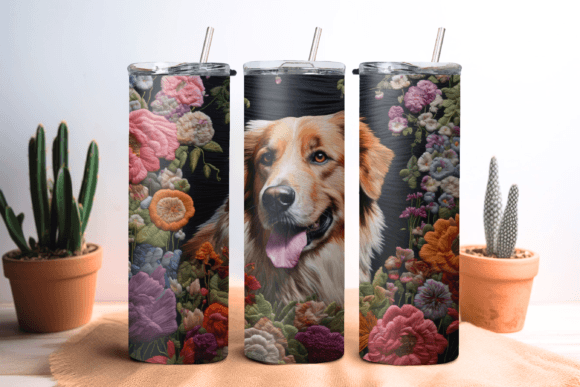
Opening the Embroidery Dog Tumbler Wrap file, the first thing that hits me is the sheer charm. This design is unapologetically cute, the kind of dog artwork that makes people stop mid-aisle at a craft fair and smile. The AI-generated illustration has a soft, almost storybook quality, with a friendly canine face that feels warm and inviting. It’s not overly detailed or farmhouse rustic; it leans more toward a modern, whimsical pet portrait that would appeal to a wide range of dog lovers.
Because it’s built as a tumbler wrap, the proportions are already optimized for a tall, slim canvas. That 9.3 x 8.2 inch size, paired with 300 DPI resolution, gives me plenty of room to work with when converting this into a machine embroidery design. I immediately see potential for something that can be a focal point rather than a tiny accent. The fact that both straight and tapered versions are included is a thoughtful touch—it means I can test placement on different bag shapes without having to manually distort the artwork.
However, the phrase “Not seamless” in the product description is important. This is a standalone graphic, not a repeating pattern. That’s fine for most embroidery applications, but it means I won’t be using it for all-over prints on fabric by the yard. For a craft fair product, a single impactful placement is often exactly what you want.
Where This Design Shines on Handmade Products
When I look at this graphic through the eyes of an embroidery digitizer, I’m not thinking about tumblers—I’m thinking about tote bag design, apron embroidery, and tea towel embroidery. The tall, portrait orientation of the dog artwork is perfect for the front of a canvas tote. Picture a natural cotton tote with this cheerful dog stitched in vibrant threads, displayed on a hook at your booth. It’s an instant “Oh, I need that” item for anyone who loves their pup.
On a kitchen apron, the design would sit beautifully on the bib area, adding a playful touch without overloading the garment. For tea towels, I’d position it in the lower corner or center-fold, letting the dog’s face peek out when the towel is draped over an oven handle. The soft, friendly expression makes it ideal for a handmade product that feels like a thoughtful gift rather than a mass-produced trinket.
I also see strong potential for embroidered patch applications. The design’s clear silhouette and distinct facial features would translate well to a patch around 4 to 5 inches tall. A patch like this can be sewn onto denim jackets, backpacks, or even a small shop product like a fabric pouch. The fact that it’s not overly complex means it will read clearly even at a slightly reduced size, though I’d avoid going too small—tiny details in the eyes or muzzle might close up in dense stitching.
For Etsy sellers and boutique makers, this design is a ready-made asset for creating a cohesive line of pet-themed items. A matching set of a tote bag, a zipper pouch, and a patch would make a compelling bundle. The design’s universal appeal crosses age groups, so it’s not limited to a niche market; it’s a safe bet for general craft fairs.
Practical Embroidery Considerations: Stitch Density, Fabric, and Size
As I always remind myself before committing to production, a beautiful graphic doesn’t always translate to a flawless embroidery file without careful digitizing. The Embroidery Dog Tumbler Wrap artwork is upscaled and AI-generated, which means there may be some softness in the lines or slightly irregular edges that need to be cleaned up during the digitizing process. I’ll need to check for excessive nodes or jagged curves that could cause unnecessary trims and jumps in the stitch file.
Stitch density is a key concern. The design appears to have a moderate level of detail—the dog’s fur texture, eyes, nose, and maybe a collar or bandana. If the original artwork includes subtle shading or gradients, I’ll need to simplify those into flat thread color areas. Too many tiny color changes can make the design tedious to embroider and increase production time, which eats into profit margins for a craft fair product.
Fabric choice matters enormously. I would test this design on a medium-weight cotton canvas first, as it’s forgiving and holds stitches well. On textured towels, I’d be cautious—the dog’s face might lose clarity if the terry loops push through the stitches. A smooth, tightly woven tea towel or a high-quality apron fabric would be a much safer bet. For dark fabrics, I’d ensure the thread colors pop by using a light underlay or selecting slightly brighter thread shades than the artwork suggests.
When placing the design on a cap, the curved surface requires careful thought. The tall, narrow shape of the tumbler wrap might need to be adjusted or rotated to avoid distortion on the crown of a cap. I’d probably test a smaller, pedestal-style version of the dog’s head alone for headwear, rather than using the full 9.3-inch height.
Display, Photography, and Buyer Engagement
At a busy weekend craft fair, your booth has mere seconds to capture someone’s eye. The Embroidery Dog Tumbler Wrap has a distinct advantage: it triggers an emotional response. A well-stitched version on a tote bag hanging at the front of your display will draw in dog owners like a magnet. I always recommend creating at least one real mockup—not just a digital preview—so you can photograph it in natural light. A bright, crisp image of the embroidered tote leaning against a basket of fresh flowers or a cozy chair will elevate your Etsy listing and make the product feel tangible.
For booth display, I’d group several items featuring this design together. A tea towel, a small zipper pouch, and a patch all showing the same dog motif create a sense of brand consistency. Customers love being able to pick up a matching set. The design’s generous size looks best as a focal point, so avoid overcrowding it with other competing elements. Let it breathe.
Another practical note: because this is a digital embroidery file (once digitized), you can batch produce easily. I’d hoop multiple pieces of cut fabric in succession, using the same thread color set, and stitch them out one after another. This efficiency is crucial when you’re restocking inventory for a busy sales season.
Designer Notes and Pre-Production Checklist
Before I’d put this design into my production rotation, I’d run through a few critical steps:
- Test on scrap fabric first. I never skip this. A simple cotton swatch can reveal a lot about how the stitches lay and whether the design needs density adjustments.
- Review thread contrast. The dog’s features need to be clearly visible. I’d choose a medium-dark thread for outlines if the artwork’s edges are soft, to give the design definition.
- Confirm hoop size. The artwork is 9.3 x 8.2 inches, but after digitizing, the embroidery field might shrink slightly. I’d ensure it fits comfortably within a 10x10 or larger hoop, leaving room for the needle to move.
- Inspect stitch density. AI-generated artwork can hide areas that are too dense with solid fills. I’d manually review the digitized file to avoid puckering or thread breaks.
- Use the right stabilizer. For a tote bag, a medium-weight cutaway stabilizer works best. For a tea towel, a tear-away with a light topping might be better.
- Create at least one real mockup. This is non-negotiable. A physical sample lets you check color accuracy, feel the texture, and photograph it for online listings.
- Compare fabric colors. A design that looks wonderful on natural canvas might wash out on a bright white or black background. I’d test a few swatches.
- Confirm commercial licensing. The product description doesn’t explicitly state the terms, so I’d reach out to the seller to verify that this digital embroidery file (once digitized) can be used on finished products sold commercially. This is a must for any small shop product.
I’d also note that the product is listed under Print Templates and Graphics, so I’m treating it as a design asset that I’ll turn into an embroidery-ready file. The upscaled AI generation means I should double-check for any artifacting or odd pixelation that could affect the stitch quality. If the file is smooth at 300 DPI, it should digitize cleanly.
Final Verdict: A Strong, Emotion-Driven Design for Craft Fair Makers
The Embroidery Dog Tumbler Wrap is the kind of design that never fails to sell because it connects on a personal level. It’s not a complex, seasonal graphic that only works for a few weeks; it’s a year-round crowd-pleaser. For a handmade product seller, that’s pure gold. I can see this becoming a signature piece in a pet-themed collection, especially when paired with a simple, elegant font for a name or a short phrase like “home is where the dog is.”
As long as you take the time to digitize thoughtfully, test thoroughly, and present it on high-quality blanks, this design will perform beautifully at craft fairs, on Etsy, and in boutique shops. It’s a smart addition to any commercial embroidery catalog, and I’m confident it will catch the eye of dog-loving customers every time.